Friday, December 16, 2016

Why Roaches Rock

The first typical reactions when people hear or see our Roaches, "Yuck!" and "Ew!"
The typical remarks at the end of our visit, "Wow!" and "These are so cool." People ending up really enjoying the roach visits.
What happens during our visit that changes so many minds?
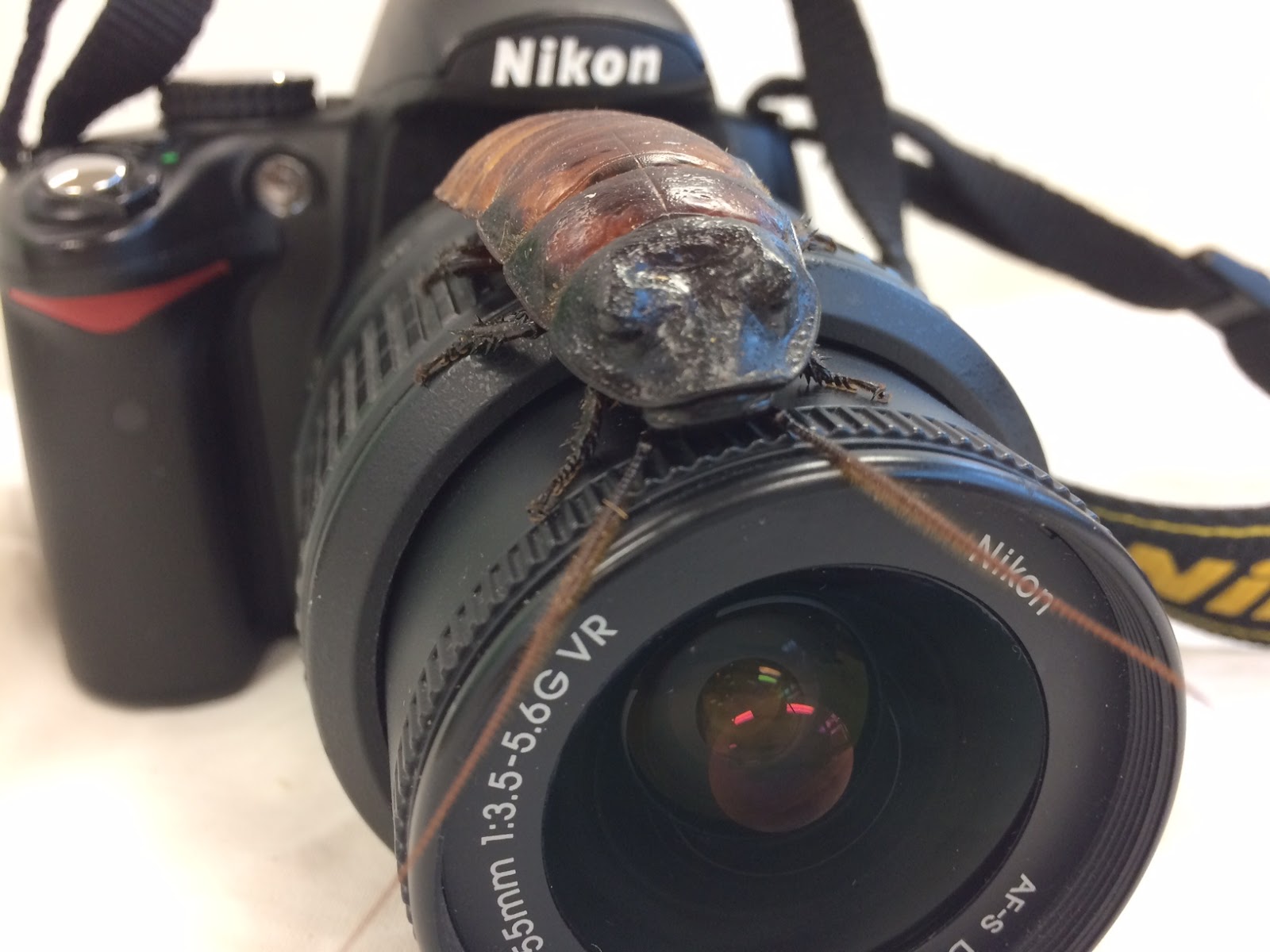

While the artists are drawing, photographing and observing this seemingly repulsive animals, I like to share some facts:

- Madagascar Hissing Cockroaches are not the same roaches that people find under their fridge.
These animals are actually rather rare. Not because they're endangered, in fact, they're quite popular as pets. But their natural distribution is limited to the island of Madagascar. Some scientists want Madagascar to be considered the 8th continent because the plants and animals are not found anywhere else in the world. The ecosystem on this island is astoundingly specific. Even though this roach is not extinct in the wild, Madagascar is in of wildlife conservation.

4th Grade drawing with model

- There are over 3,500 species of roaches on the planet. And believe it or not, a lot of them are not considered pests. The few species that are associated with humans and being dirty are actually dirty because of the mess we leave for them, not the other way around. Roaches can't spread contaminants unless we provide it first. Roaches don't like being dirty. Roaches even clean themselves like cats! The Madagascar Hissing Cockroach in particular is very clean. It's role in the ecosystem is to keep the rainforest healthy. They can't very well fill their niche if they're spreading disease.

- Despite what you see on TV, Madagascar Hissing Cockroaches cannot bite you. Their mouths are similar to that of a grasshopper. Think of it this way: These animals feed on decaying plant matter. Does an animal need flesh ripping teeth to eat a rotten banana? No! They're bodies aren't built for scaring or hurting you, they're for keeping the rainforest healthy and clean. They also lack stingers, pinchers, venom, and wings.

We donated a dozen from our own colony to this very enthusiastic class!
- In my opinion, their role in the environement translates into these animals being "Eco friendly" pets. Yes, they need heat, but otherwise are low-cost. I feed my colonies organic table scraps. This could be a great way to reduce your carbon footprint. Some other eco-friendly pets include the black soldier fly and earth worms. But let's get into that on another post.


I have tons more to say about the Madagascar Hissing Roach. I didn't even get into their social habits, heirarchy, the differences between males and females or their personalities. So keep a look out for our classes and events to learn more!


-Brittany Roger

Sources:
https://today.duke.edu/2014/10/madagascarbiodiversity
https://www.lvzoo.org/animals/madagascar-hissing-cockroach/
https://www.quora.com/Why-are-cockroaches-bad
http://rosamondgiffordzoo.org/assets/uploads/animals/pdf/Madagascar%20Hissing%20Cockroach.pdf

Monday, December 5, 2016

The Tortoise and the Hare

A closer look into our Tortoise and Hare...


Tortoise- Bowser is a 13 year old, male Russian Tortoise. This is his 3rd home. His dominating personality and long lifespan makes him quite a commitment.
A tortoise is not a turtle. Turtles are semi aquatic animals with webbed toes, a hydrodynamic shell. While the tortoise lives on land, can't swim and has a shell more suitable for digging.

Hare- Okay, he's not really a hare. Rocket is a Dutch Rabbit. What's the difference?  Visually, hares have longer legs and more angular features. The real difference is their babies. Baby rabbits (bunnies) are born hairless with their eyes close, completely dependent on their mom.  While baby hares are born independent and ready to go! Hares are not as social as rabbits.
But for our purposes, our young man, Rocket is perfect. He's fast, cute, and fun to draw!


When we bring these guys into the classroom, we let the students pet the animals and listen to The Tortoise and the Hare read out loud. Then they discuss the differences between the real and story animals, what happened in the story and what they can learn from it.
Just as an example, we introduce the students to gesture drawing. First the students only have 10 seconds to draw our animals. Then we give them a few minutes to draw the same animals.
Do they accomplish more with more time? Do they use their time wisely? Do they go slow and steady? Bring us in and find out!


-Brittany Roger

Tuesday, November 15, 2016

Animals You Didn't Know We Had

Our mission includes caring for animals that don't make it to class. Sometimes we take in animals that need a good home and find out that they do not meet the standards for class visits.
Reference our the standards of classroom-safe animals here.

Personality. Once all the other factors are fully addressed, the last and most uncontrollable factor is the animal's personality. Over time, many animals learn through consistently interacting with people that we are not going to hurt them, and even associate us with their food, warmth and safety! I like to call this"conditioning". Conditioned snakes, lizards and even spiders and scorpions can make great class visitors. But once in a while, there is an individual who is simply a grump. And though you won't see them in class, we love and appreciate these animals for who they are and give them the same love and care as all the friendly beasts.

At my house, the animal who fits this criteria is Scandal. She looks very similar to her cage-mate, Dexter, who we use in our Heredity programs. Scandal is even more willing to bite than wild snakes I've picked up. Scandal has been pampered since 2010, so I'm confident she's adjusted to her life with me. Her check ups result in a perfect review. Black Rat Snakes like Scandal are considered an adult when they reach 4 years old, 4 ft long and weigh over 400grams.


Which means she is just a grumpy lady. What does a grumpy snake do? Sure, she is likely to bite me. But it also means that she frequently rattles her tail to warn me away. If I interact with her against her wishes she will also musk on me. It's like an invisible stinky pee- talk about defense! She does NOT like being held or taken out of her cage. She likes to be warm, hidden and alone.
I'm confident that if she lived out in the Maryland wild, she would do just fine! So fine that one may even suggest that captive life isn't for her and she should live free. And I don't whole heartedly disagree. But Scandal was a captive born and raise snake- making it illegal to release her outside. Even though Scandal is a handful, we love her and give her everything a grumpy snake needs!

-Brittany Roger


Monday, October 31, 2016

Goodbye, Sun

This is the time of year we start to worry about seasonal depression. A lack of sunlight can cause us lethargy and sadness. But did you know that animals also feel the effects of lacking sunlight?

If you've been following The Drawing Zoo on our Instagram or Facebook, you've probably notice that we house many of our animals outside in the summer. Or you may be familiar with the image of lizards, snakes or turtles basking on a rock in the sun. For diurnal animals, (animals that are awake in the day), the rays from the sun don't only keep them warm, but are necessary for them to digest their food and absorb the Vitamin D which allows them to digest their food, and specifically absorb calcium. When we keep animals out of their natural environment, it our responsibility to mimic the elements as best we can. This includes UVB rays.


This is the time of year we've moved the animals inside because the temperature is not warm enough for the animals to keep healthy. "Then how do they get their UVB rays?" you may ask. We buy ZooMed UVB spectrum bulbs! Although they can't replace the sun, these bulbs supplement the animals' UVB needs during the colder months. In fact, I just changed all our bulbs this week. Buyer beware- even if the light still works, these bulbs fail to emit the necessary rays for more than 6-12 months. Since our animals spend half their time in the sun (and therefore, not using the bulbs) I feel comfortable changing my bulbs every Fall.


The concequences of failing to provide proper lighting are very grim. The most common result is Metobolic Bone Disease. A lizard with MBD can have a malformed jaw, legs, a kink in their spine. While turtles and tortoises will grow deformed shells and beaks.

Please note, that keeping animals like ours is an ever developing art. As veterinarians and zoologists learn more about these animals, and captive methods evolve, it is also my responsibility to keep up. This information I'm sharing right now will likely be improved upon in the near future!

-Brittany Roger

Sources: http://greenigsociety.org/heatlighthumidity.htm

Monday, October 3, 2016

Why The Drawing Zoo?

For those who wonder "How did such a business begin?" and "Why would I try something so new?"

All roads led me here.
Since I was 5 years old, I could wield pencils and paints. I’m lucky that my proud parents saw my passion and embellished me with art lessons. And one day at age 6, I came home with a big black rat snake. I found it in our creek, picked it up and allowed it to drape around my shoulders. And a fire was ignited inside me. From that moment on, I’ve been able to love, understand and draw beings that make most people recoil. Thank goodness, my parents saw my passion and supported it.

When I was in college, I was volunteering at Baltimore’s then exotic animal rescue. At the time I was also illustrating, photographing and cataloging plants and animals for the Smithsonian. A dream come true. I wanted to go back in time and high-five 6-year-old me.

Prepping a Coral Snake specimen for photography.
Bathing and drying an Albino Burmese Python at Charm City Reptile Rescue.
After a 14-hour shift waiting tables, I came home and greeted my darling rescue iguana. It was late and I was supposed to be creating a thesis paper for a grad school. But all I wanted to do was love on him and paint him. And why not? That’s what I’m good at. Art, natural science and loving the unlovable. Shortly after, I got a request from an old professor at MICA. She was teaching Nature Drawing and remembered the girl with the odd rescue pets. She asked if I’d be willing to bring them in one day to model. And the light bulb lit up over my head! I had my thesis.

Pierce, the Iguana, was my first, most severe rescue and most popular model. 
Graduation from MICA' Masters of Business of Art & Design

I tested my service throughout 2012 and incorporated The Drawing Zoo in February 2013. The service has been evolving fast. What started out at a resource for college art students has turned into a forward thinking arts integration service that meets Common Core requirements in elementary school arts and science. 

Refinement.
While building my brand, I secured a job teaching at The Legacy School. My learning curve was steep, as I was responsible for lesson planning, the supply closet, the syllabus and of course-classroom management. I enjoyed this huge experience for two and a half years. I had the pleasure of teaching art in Fall, Spring and Summer and learned to accommodate students with all kinds of learning differences and needs.
Immediately after gave my tearful "good-bye" to the Legacy community, I participated in "Artists as Educators" seminar from The Kennedy Center. I learned the mission, applications and methods of teaching Arts Integration. It was a validating experience- as The Drawing Zoo naturally met every criteria with gold stars!
My experience at with The Kennedy Center and recent friendship with Young Audiences fueled my enthusiasm for taking the Teaching Artist Institute Seminar and Training. Through this experience, I test and revise my current lessons to ensure that on top of having an inspiring experience, the students will be able to self assess, reflect and retain the information.


As the person responsible for The Drawing Zoo, I am constantly in a state of refinement and thinking ahead.
Lesson planning is a big part of my "behind the scenes" job. When a teacher is interested in booking a visit, I like to communicate what my procedures and plans are to ensure they and their students are getting the most value out of our time together!

In addition to "freelancing" our services, The Drawing Zoo has an awesome partnership with Arts Everyday.  Our programs meet Common Core Science Standards and Fine Arts Standards. Our program options are evolving even fast!

Students learn how snakes move by building their own model.
We are developing programs that can help kids retain their math requirements, literature standards and are even piloting a program with FutureMakers that teaches kids about mechanics and animal locomotion.
Keep an eye on our Facebook and website to be the first to book these innovative learning experiences.

-Brittany Roger

Wednesday, September 14, 2016

Escher Update

Some of you may know, there is a new iguana at The Drawing Zoo. Pierce's passing still weighs heavy on me, and in my heart he will never be replaced. But Iguanas are heavily exploited animals and it felt awful to have all the resources to care for one and not. Taking care of an iguana got me back into my daily routine, which is helpful in the mourning process.


On August 31, I took Escher for his/her first check up. He/she is 98 grams and one year old. Escher is underdeveloped for a yearling and has suffered several broken toes, a tail that's been broken at least twice and burns all over his/her body. Since Escher has come to live with me, he/she had not eaten on his/her own accord. I feed Escher but placing food in his/her mouth when he/she tries to bite me. The fecal test also revealed an abnormally large quantity of bacteria.
Collectively this was not good news. But it is common. Young iguanas in the pet trade endure injury and stress in the shipping process that gets them into stores or expos. The iguanas who survive the shipping process either die of stress or malnutrition in the store (depending on how specialized the store is) or end up as an impulse purchase. Most iguana owners, even in 2016, don't know the essential needs and expenses of these tropical lizards. Or they figure it out too late.

The day I took Pierce '09
As depressing as this reality is, it's nostalgic for me. When I took Pierce (2009) he was in nearly the exact same condition. Purchased on impulse twice. By the time I took him, he was covered in burns, gangrene and was underdeveloped. Even though he grew to an impressive size, he never grew to his full potential. If you knew him, you know he made up for in personality!


Fortunately for Escher, I am seasoned in the art of caring for an ill iguana. Almost 4 weeks after bringing Escher home, he/she is taking medicine like a champ, and most importantly- eating and drinking with no help from me!


-Brittany Roger

Tuesday, August 2, 2016

Availability

"When are you available to visit? How far in advance do we need to book you?"


Our policy is "First come, first serve". However, to maximize customer satisfaction, we encourage schools/teachers to email The Drawing Zoo when they're planning their budget and syllabus for the semester. This give us a heads up that they'd like a visit, we will mark our calendar. Then we get in touch to smooth the details 4-6 weeks in advance.

The Drawing Zoo offers its Partnered Programs and custom services in Baltimore City, Baltimore County, Carroll County and Harford County, Howard County and Anne Arundel County. We are available Monday through Friday both during school hours and after hours.

How to book a visit:
Email thedrawingzoo@gmail.com or call 410-833-6876.
We need to know your class's age, size, curriculum goals, desired date and location.
We give you the best service possible.
Once the details are agreed upon, we will send a "confirmation" email summarizing the agreement and attached invoice.
2-3 school days before the visit, we send a "reminder" email containing the same information.

Keep up with us on Facebook to receive discounts and special offers.